Local SEO for Kolkata: How the Right Website Structure Boosts Your Rank
Building a high-performing website for the Kolkata market goes beyond great design. To truly rank well in local searches, your site needs a robust technical foundation that helps search engines understand exactly what you offer and who you serve. This essential groundwork is often the difference between a website that gets found and one that gets lost on page two. The ideal partner for this process is a seasoned Website Development Company in Kolkata that prioritizes structure from day one.
What is Technical SEO and Why Does It Matter for Local Ranking?
Technical SEO involves optimizing the backend framework of your website to improve how search engines crawl, index, and render your pages. It matters for local ranking because a technically flawless site is prioritized by search engines, leading to better visibility when Kolkata residents search for your services.
A good technical foundation ensures your site is accessible and fast. Think of it as the blueprints and materials of a house; no matter how beautiful the furniture (design) is, a weak foundation will cause problems. For local businesses, issues like slow loading times or broken links can drastically hurt your performance in localized searches, especially since many users search while on the go using mobile devices.
How Does Site Speed Directly Impact SEO in the Kolkata Market?
Site speed is a critical ranking factor because slow websites frustrate users and cause search engines to reduce the amount of content they analyze on your domain. Google specifically favors fast-loading pages because they provide a better user experience.
If your site takes more than three seconds to load, studies show that nearly half of your visitors may leave immediately. This increases your "bounce rate" and sends a negative signal to search engines about your site's quality.
- Audit Your Load Time: Use tools like PageSpeed Insights to check how quickly different elements of your pages load.
- Compress Images: Large, unoptimized images are the number one cause of slow speeds. A good developer will automatically compress and use modern image formats (like WebP).
- Optimize Code: Removing unnecessary, cluttered, or duplicate code (minification) speeds up the site’s rendering process significantly.
How Does Internal Linking Improve Rankings and User Flow?
Internal linking is the process of connecting one page of your website to another, which helps search engines discover all your content and distributes authority across your site.
When executed correctly, internal links guide users and search engines to your most important pages—like your service pages or contact information. This not only encourages users to explore your site further but also shows search engines which pages hold the most importance (often called on-page signals). A well-structured link architecture is particularly crucial for local businesses to connect broad service pages (e.g., "Digital Marketing Services in Kolkata") to more specific location pages (e.g., "SEO Services in Salt Lake").
What are the Best Practices for Creating an Effective Internal Link Structure?
The most effective internal linking structures are deep, relevant, and consistently executed.
- Contextual Linking: Always link related topics within the body text of a page. For instance, in a blog post about web design costs, link directly to your service page for "Custom Web Design."
- Use Descriptive Anchor Text: The text you use for the link (anchor text) should accurately describe the destination page. Avoid generic phrases like "click here." Instead, use targeted phrases like "Kolkata web design portfolio."
- Prioritize Deep Links: Ensure your homepage and high-authority pages link deep into your site, distributing authority to newer or less visible pages.
- Avoid Orphan Pages: Every page on your website should be reachable by at least one internal link. Pages without any inbound links are often called "orphan pages" and are rarely indexed by search engines.
How Should a Kolkata Business Structure its Website for Local Search Intent?
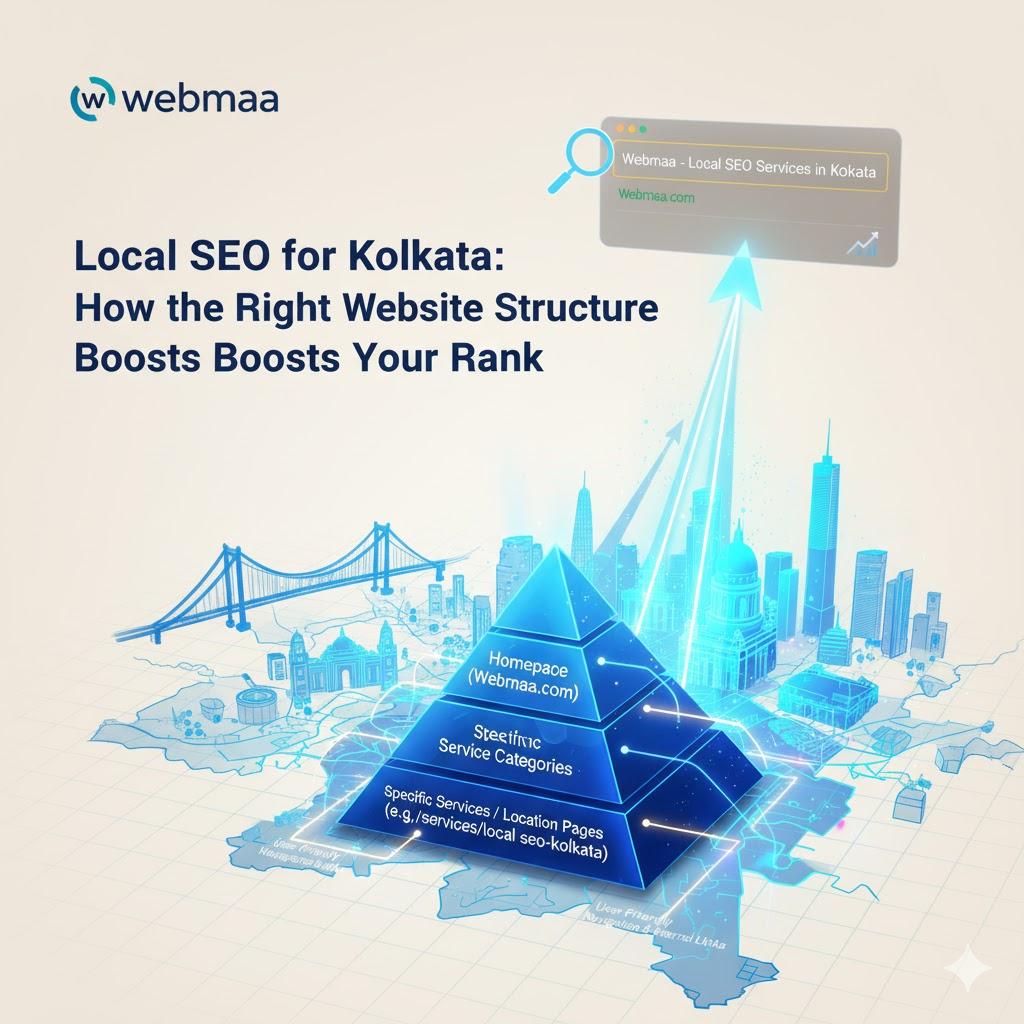
The most effective website structure for local SEO mirrors how your local customers search for your services, organizing content by location, service, and intent. This ensures that when a user searches for a service plus a specific area (e.g., "graphic design company in Salt Lake"), a perfectly optimized page is ready to meet that specific need.
At Webmaa, we implement a 'Hub and Spoke' model. Your main service pages act as the Hubs (high-level topics), and your more specific, localized pages (or blog content) act as the Spokes, linking back to the main Hub.
Why is a Clear Site Hierarchy Vital for AI-Driven Answers?
A clear site hierarchy is vital because modern search algorithms rely on understanding the relationships between your pages to provide fast, accurate answers to conversational queries and voice searches.
When a user asks a question like, "Where can I find the best mobile app development services near Esplanade?" the search engine needs to quickly identify the authoritative, locally relevant page. If your site structure is messy, the search engine might struggle to determine which of your service pages is the most relevant.
Here is an example of an ideal, easy-to-read hierarchy:
- Homepage $\rightarrow$ (Links to)
- Primary Service Pages (Hubs): /web-design/, /seo-services/, /branding/ $\rightarrow$ (Links to)
- Location-Specific Pages (Spokes): /web-design/kolkata/, /seo-services/salt-lake/, /branding/new-town/ $\rightarrow$ (Links to)
- Blog/Case Studies: /blog/mobile-first-design-kolkata/
If you are currently evaluating options, know that choosing the right Website Development Company in Kolkata is a decision that affects your marketing for years to come. Focus on partners that speak clearly about site structure.
How Does Canonicalization Prevent Duplicate Content Penalties?
Canonicalization prevents penalties by telling search engines the single, preferred URL for a piece of content, eliminating confusion caused by duplicate pages.
Duplicate content often happens naturally—for instance, if you have a product accessible via both domain.com/product-a and domain.com/category/product-a, or if a URL has a trailing slash versus no slash. While this is not an outright "penalty," it can dilute your SEO efforts as search engines waste time deciding which version to index, often prioritizing the wrong one.
Best Practice: Implementing the Canonical Tag
The canonical tag ($\text{rel="canonical"}$) is a line of code placed in the head section of a duplicate page that points to the original, authoritative page.
$$<\text{link rel="canonical" href="[https://www.yourdomain.com/preferred-page-url](https://www.yourdomain.com/preferred-page-url)"}>$$
This tells the search engine, "Index this page, but treat the authority as belonging to the preferred URL." This is essential for e-commerce sites in Kolkata that list the same product under multiple categories or use complex filtering parameters.
Conclusion: Setting the Stage for Local Success
Ultimately, local SEO success in a competitive market like Kolkata is determined by the quality of your website’s foundation. It is the technical structure—speed, linking, hierarchy, and clarity—that allows your well-written content to perform optimally. By focusing on these structural elements, your website will be naturally favored by search engines, ensuring you effectively capture the high-intent local traffic your business deserves. Don't let technical debt hold you back; build your digital future on a rock-solid, SEO-friendly framework.
Frequently Asked Questions (FAQ)
What is the difference between On-Page SEO and Technical SEO?
On-Page SEO refers to the content elements you see (text, images, headings, meta descriptions) while Technical SEO refers to the structural and backend elements (site speed, mobile-friendliness, security, code structure) that impact how the site functions. Both are required for strong performance.
Should I use subdomains or subdirectories for my Kolkata location pages?
For local SEO, using subdirectories (e.g., yourdomain.com/kolkata-service/) is strongly recommended over subdomains (e.g., kolkata.yourdomain.com/). Subdirectories pass more direct authority from your main domain, helping your local pages rank faster.
How often should my website structure be audited?
Your website structure should be audited at least once a year, or immediately following any major website redesign or migration. Regular audits help identify broken links, slow pages, and structural errors before they harm your ranking.
Does a simple, flat website structure perform better?
Generally, yes. A "flat" structure, where users can reach any page on the site within a few clicks (ideally three or less), helps distribute page authority more efficiently and improves the user journey, which search engines favor.
What is the ideal website structure for e-commerce sites in Kolkata?
E-commerce sites should follow a deep categorization structure: Homepage $\rightarrow$ Category $\rightarrow$ Subcategory $\rightarrow$ Product Page. This clear segmentation helps search engines and shoppers quickly navigate a large inventory.
How long does it take to see SEO results after a website redesign?
You should see initial positive changes, such as improved indexation and speed scores, within 4 to 8 weeks after a proper SEO-focused redesign. Significant ranking and traffic increases typically take 4 to 6 months of consistent content and link building.
Leave a comment
Your email address will not be published. Required fields are marked *
